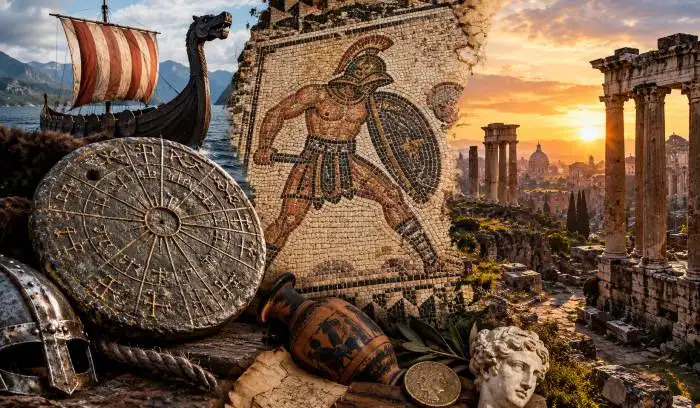
True-to-life ancient myths and legends can uncover fascinating links between stories and real events from the distant past. The story of warrior women, lost cities, strong empires and mysterious navigation techniques was dismissed as fiction for centuries. But archaeological evidence and modern scientific study have revealed information that some of these legendary tales might actually be based on real people, places and practices.
History proves that truth is sometimes stranger than legend, from Viking sunstones to the legendary Amazons, from the ancient city of Troy, Roman gladiator battles and the Hittite Empire.
Viking sunstones may have helped with navigation
Ever been curious to know just how the Vikings navigated across enormous, open seas? The Norse sagas chronicled tales of 'sunstones'; mystic crystals that were said to reveal where the sun was, even when covered by overcast skies; allowing Vikings to navigate, centuries before the creation of the compass. Scientists found a piece of Iceland spar in 2013 that dated back to a 16th century shipwreck.
Experiments concluded that the mineral polarised light allowing for the position of the sun to be established even when it was unseen; as described by the Norse sagas. Although this was centuries later than the time of the Vikings it is possible that this technique enabled them to navigate the seas for so long, so accurately without modern technology.
Read More: 6 Historic Places That Inspired Legendary Tales From History

The mythical Amazons may have been real people
Legends told in Ancient Greece of warrior tribes made up exclusively of female Amazons, whose independent tribes of Amazonians fought as formidable warriors as men. The myths, people generally dismissed as flights of fancy or frightening tales to warn of the dangers of female independence.
Recent digs carried out in Azerbaijan revealed graves, dating back to the Bronze Age, containing skeletons of women armed with arrowheads, daggers and even a mace-even bearing the skeletal scars of years astride a horse-and with remains showing proof of archery.
Researchers made similar discoveries in Russia, Armenia and Kazakhstan so Bronze Age warrior women became at least the subject of myth and quite possibly, a very real part of history.
Troy did exist and it's been excavated
Approximately in the 8th century BC, the ancient Greek poet Homer reported that a magnificent city named Troy was besieged for 10 years, ever since their prince kidnapped the wife of the King of Sparta. Through the story of a famous poem, he recounted the tale of the epic heroes Achilles and Hector, divine interventions from the Greek Gods, and the ultimate fall of the city at the hands of a fake wooden horse. For years, people have considered this fiction.
In the 1870s, archaeologist Heinrich Schliemann excavated the site called Hisarlik in modern-day Turkey, where he unearthed a massive fortified city that has been rebuilt many times over the years (as pictured) and uncovered artifacts and traces of battles during the time that Homer described, therefore demonstrating that Troy did exist after all - most of it, anyway, remained legend.
Gladiators did indeed fight lions in the arena
Up until now we've only ever known about the games people fought animals in Roman times through writing and images such as the mosaic shown below; however, in 2025, researchers studying the remains on Driffield Terrace, York (the only fully excavated and understood Roman gladiator burial in the world) claimed to have found definitive physical evidence of a human and lionfight.
The analysis of the skeleton of one youth discovered in 2004 showed clear damage to the pelvis (likely from lion jaws), as scholars assumed the damage did not fit any standard burial damage observed in other skeletons within the cemetery.
El Dorado, the famous city of gold, may have existed after all
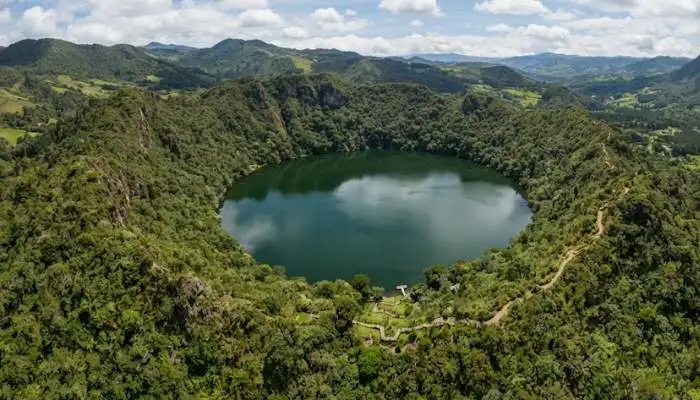
European explorers pursued the myth of El Dorado for hundreds of years; they sought the treasure city nestled deep in the Amazon, ruled by a King so wealthy he reputedly smeared himself in gold dust and then immersed himself in the waters of Colombia's Lago Guatavita (pictured).
The hunt for the 'fabled city of gold and jewels' led to countless deaths, and people began to use 'El Dorado' as a by-word for anything elusive and unobtainable. Science has brought the fable crashing back into reality.
In 2010, researchers used satellite and LIDAR mapping of more than 200 immense geometric earth works spread over 200 miles in the upper Amazon dating back between AD200 and AD1283 to prove the existence of a complex society exactly where a desolate and uninhabitable wilderness was previously presumed: 'the true El Dorado.
You May Also Read: The Ultimate Adventure: Exploring World Cultures Through Travel
The Hittites were a real and powerful civilization
For centuries since ancient texts (notably the Old Testament) characterized them as somewhat ethereal figures—scholars thought the biblical Hittites were purely legendary devices of scriptural authorship.
All of this changed during the 19th and early 20th centuries when excavations by Hugo Winckler and his team unearthed the capital of the Hittite Empire, Hattusa, at the present-day Turkish site of Boazky, and produced massive amounts of cuneiform archives in 1906.
This cache included thousands of inscriptions detailing a prominent central Anatolian bronze age empire that existed roughly between the 17th and 12th B.C. and dealt with the Hittites' laws, international treaties and correspondence, as well as their religion.
FAQs
1. Were Viking sunstones really used for navigation?
Iceland spar can polarize light and may have helped sailors identify the sun's position even when clouds blocked it.
2. Were the Amazons real?
Archaeological discoveries of armed female warriors in ancient Eurasia suggest that the stories of Amazon warriors may have been inspired by real warrior women.
3. Did the city of Troy really exist?
Yes. Archaeological excavations at Hisarlik in modern-day Turkey uncovered the remains of an ancient fortified settlement identified with Troy.
4. Did Roman gladiators actually fight lions?
Evidence from a Roman burial site in York has been interpreted as possible physical evidence of a person being attacked by a large carnivore, potentially a lion.
5. Was El Dorado a real city of gold?
There is no confirmed evidence of a literal city made of gold. However, archaeological discoveries show that complex societies once flourished in regions connected with the El Dorado legend.
.